


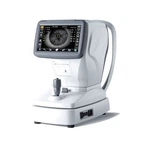


The design principle of most computer refractometers is based on indirect ophthalmoscope, which uses two objective lenses or focusing mirrors and a beam splitter. The light source enters directly from the pupil edge, and the detection cursor can move along the axial direction of the projection system. The projection lens, whose image will be at infinity, will be clearly focused on the retina of the emmetropic eye; if the eye to be inspected is ametropia, the detection cursor will move back and forth to make the image focus on the retina.
Modern computer refractor designs generally have two main features:
1. Adjustment control
Control of accommodation is especially important for most refraction methods. Almost all refractometers require the subject to look at the test cursor or the cursor image, which stimulates the adjustment and makes the test result overcorrected or undercorrected. Although the test cursor is designed at infinity through the optical path, because the instrument is very close to the subject Therefore, in the design process, the test cursor is "fogged", and before the measurement starts, the subject first sees a "foggy" cursor to relax accommodation, but cannot completely remove near-sensory accommodation.
2. The detection light is infrared light
The detection light of the currently used computer refractometer all adopts infrared light with a wavelength of 800-950 nm. The reasons are: ①Infrared rays are absorbed less by the tissues in the eye than visible light, and more light is reflected by the fundus. Therefore, the loss of light energy after the detection light passes through the intraocular medium is less, which is especially important for measuring eyes with turbid refractive media. ②For the eye to be inspected, the detection visual mark and the detection light are invisible, which better overcomes the adjustment problem caused by the measurement of the visual mark.
